From time to time, my wife takes me on deep dives into Khmer culture. Every September we travel to her native village to celebrate Pchum Ben, the highest religious holiday in Cambodia.
Very briefly, Pchum Ben is the festival of offering food to the ghosts of ancestors who leave hell for a fortnight. Indeed, when we went to the pagoda, people were either contributing sticky-rice cakes or else cash to the monks.
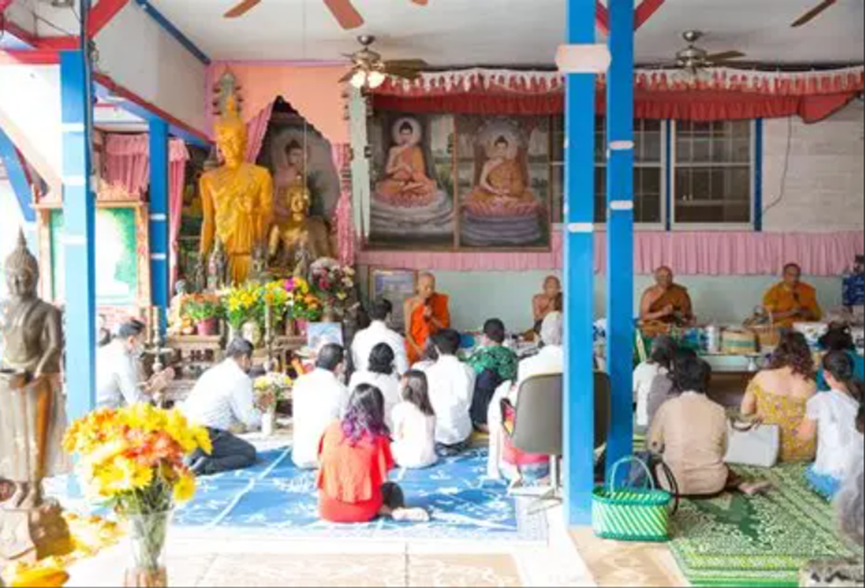
Pretty much the scene I witnessed. The head monk blesses the kneeling gatherers, who then give offerings of food or cash to the monks seated alongside.
However, what I saw at the pagoda was not people undergoing a personal religious experience from offering food to the ancestors. Rather they were just mindlessly going through the motions of what one is supposed to do on Pchum Ben.
I do not wish to take this observation as a condemnation or negative comment. Rather, this repetitive act, performed collectively by hundreds of other worshippers, brings them into contact with the deep roots of their traditions. I saw the entire pagoda experience of these throngs of local people as immersing themselves in a tradition of community solidarity.
Western religions stress individual communication with God through prayer, meditation, and self-reflection. I saw none of this at the pagoda. It was a group exercise, with hundreds of Cambodians reaffirming their connections to their culture and traditions. If anything, they were losing their individual identities by submerging their psyches into the collective consciousness.
Related to this feeling of solidarity is a feeling of continuity. Cambodians can feel the flow of tradition through generations. This is why the family is so important at Pchum Ben. I could feel that sense of cohesion among the members of my wife’s extended family – infants, parents, grandparents, and even great-grandparents together, not to mention the myriad aunts, uncles, cousins, niblings, of all ages. This is not just family solidarity, but the flow of family through the generations.
The afternoon after our visit to the pagoda, a monk was invited to the family homestead to offer blessings. He chanted (in Pali, unintelligible to the thirty or forty family members kneeling at his feet) and sprinkled holy water on us. Again, this was no individual meditative experience, but rather approval from on high of the family values and traditions. In the tradition of Pchum Ben, food and cash were offered as symbolic gifts to the ancestors for the monks to distribute.
The evening after the Pchum Ben gathering (and I was told that ‘Pchum’ actually means ‘gathering’), the extended family came to our family house to party. And Wow! Did they ever party! Dancing, singing, and drinking beer for hours and hours into the night. I have to add that it seemed like good, clean exuberance. I saw no evidence of hard alcohol, drugs or sexual misbehavior. The party was all part of the family solidarity, and should be considered an integral part of the Pchum Ben ceremony.
I want to close with the observations of my wife. She is so happy when visiting her native village – even staying in the house she was born in. She is really ‘in her element’, ‘like a fish in water’, in the bosom of her extended family and all the cultural memes with which she is so familiar. She danced, sang karaoke of her childhood songs, prepared some deliciousl traditional meals, and visited old friends and relatives. Multiply this beaming happiness by the hundreds of people celebrating together in the same way, and you get a feeling for the clan happiness and reaffirmation of family values and traditions.
I said that Pchum Ben was not so much a personal religious experience but a ‘gathering’ of the clan to reaffirm its traditions. However, the transformation I saw in my wife indicates a profound personal experience, as she connected to all the clan members present.
As a post script, I want to refer you to the work of the sociologist Émile Durkheim, who in the early 1900’s outlined a sociological theory of religion. A brief summary of his ideas follows:
Collective consciousness, representing shared beliefs and moral attitudes, emerges through religious practices….. religion is less about your private thoughts and more about the shared experience of being part of something bigger than yourself. Religion isn’t some random set of ideas that people just made up. Instead, it mirrors and strengthens what society already values.
Durkheim’s observations are exactly what I observed in the Cambodian countryside over this Pchum Ben holiday.