Here’s an interesting hypothesis: the behavior of followers of any religion is diametrically opposed to the main principles of their religion. For example, the main message of Christianity is “Love thy neighbor.” But today’s Evangelicals harbor an intense hatred for blacks, Hispanics, Moslems, LGBTQs, and anyone not exactly not like themselves. Not to mention the Inquisition, the Crusades, witch-burning, the rack, etc.
One simplistic explanation is that religious people go through all the pious, symbolic motions, and therefore believe they are ‘saved’ and excused from all sorts of heinous crimes.
So what about Cambodian Buddhism? The main message of Buddhism is renunciation, detachment, aloofness, and not needing too much or becoming too attached – the ‘Middle Way’. When I look around and see Cambodians making $500 a month driving $40,000 cars, I see conspicuous consumption, not Buddhist moderation. I see debt up to their eyeballs, leading to all kinds of stress, all in the pursuit of image. Thousands of Cambodians are spending $500 for vanity license plates. Buddhist Cambodia is one of the most highly indebted countries in the world.
Cambodians are greatly attached to their families – not just to their immediate families, but to their extended families, who form the social safety net that the government cannot provide. They have one of the lowest divorce rates in the world. And yet, one of the pivotal incidents in the Buddha’s life is the ‘Great Escape’, in which he abandons his wife and baby in the middle of the night. He wanders around, unattached, for the rest of his life. Cambodians today clearly do not condone such behavior.
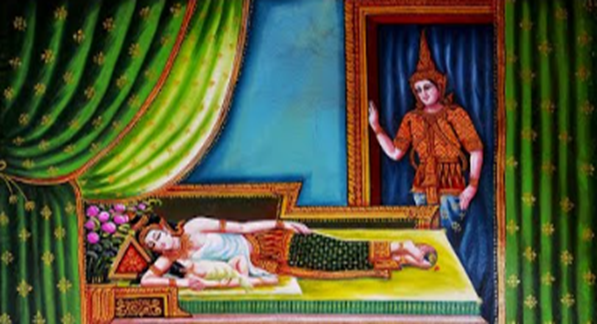
Prince Siddhartha (later to become the Buddha) abandons his wife and baby.
I attended a Cambodian wedding last week, in which a father wanted an impressive wedding for his son, and spent more than he could afford. He was hoping the wedding guests would defray the costs, as is the custom in Cambodia. He came up short by some $3000, and it nearly drove him crazy that he could not pay it. While the wedding followed all sorts of Buddhist rituals and traditions, it was not, in spirit, a Buddhist wedding.
There is, however, at least one tenet of Buddhism in which Cambodians believe and act accordingly: Karma. During the Thai border war last month, there were constant referrals to the horrible karma coming to the Thais. After the Khmer Rouge debacle, Cambodians kept asking themselves what they had done wrong, perhaps in previous lives, to merit such horrible karma at the hands of Pol Pot.
Cambodians spend a lot of time and effort at ‘gaining merit’, i.e. good karma. The daily tradition of monks begging for alms is not considered begging at all, but the monks offering people the opportunity to gain merit through their donations.
Rich men and politicians build elaborate stupas or other monuments to the Buddha (and also to themselves), in hopes of gaining merit.
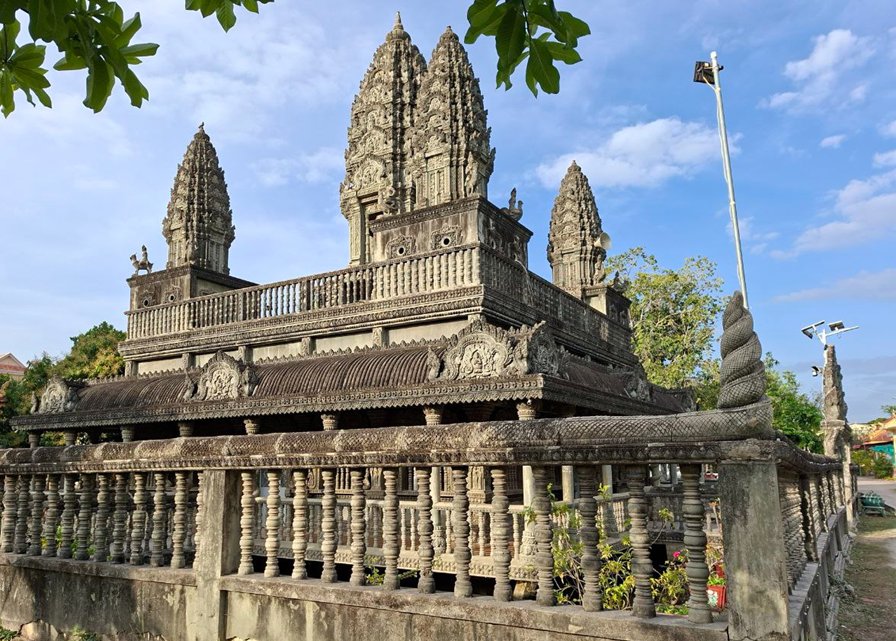
Angkor Wat copy mausoleum of Oknha & Mrs. Net Yang, Wat Kandal, Battambang
If you go into any pagoda, you will probably see paintings or sculptures or doors or windows with an inscription stating who paid for it and how much they contributed. This is a sort of conspicuous consumption and gaining merit all wrapped up in one.
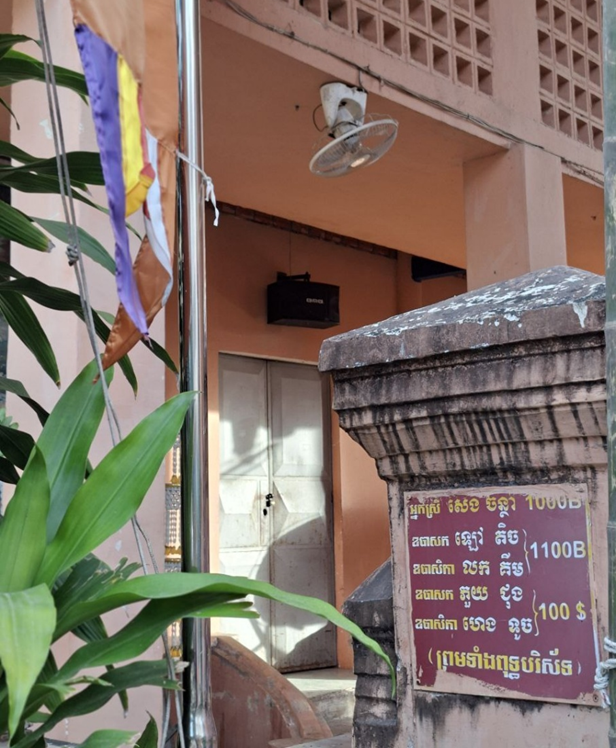
Typical donor plaque, Wat Kandal, Battambang (note Thai baht)
Cambodians, therefore, do not really adhere to the Buddhist principle of renunciation. However, they can be partially excused because the Buddhist ‘religion’ is far greater than just the original Buddhist philosophy. Some people will argue, “But Buddhism is only a philosophy, not a religion” Just go to any pagoda and you will see that Buddhism is indeed a full-blown religion, which often has little to do with the Buddha’s philosophy.