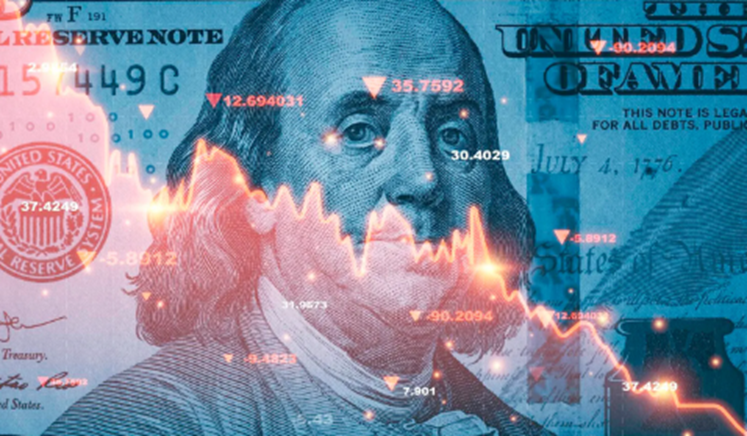
Trump has recently claimed that it would be a good thing if the US dollar depreciated. This is a common argument because if the dollar depreciates, it makes US exports seem cheaper and more attractive to foreign countries, while it makes imports more expensive, thus discouraging Americans from buying foreign products.
It’s quite a valid argument. Several years ago, many countries realized this and began a ‘race to the bottom’, trying to beggar their neighbors in lowering their currencies. The result was that nothing changed. If country A takes steps to lower its currency against country B, and if country B takes the same steps to lower its currency, the two actions cancel each other out.
Suppose, then, that Trump manages to devalue the US dollar by 10%. That means that the Chinese yuan and others will rise by 10% against the dollar. An American company that wants to buy a Chinese product (in yuan) will have to pay 10% more for the product.
In other words, a 10% tariff.
In fact, it’s a 10% tariff on every country and every product at the same time. That’s not very useful, if Trump wants to punish selective countries or selective products. That’s why he hasn’t focused on devaluation.
However, it appears that Trump is getting his devaluation anyway. The US dollar has dropped 11% against a basket of major currencies in 2025 and is poised to drop even further. It is currently at a 4-year low.
Many countries, alarmed at Trump’s erratic policies, are dumping their dollar holdings in the form of US Treasuries in favor of other currency-denoted assets. With all the selling, the US dollar will surely decline, and if the US loses its credit rating, the dollar could really plummet.
The US dollar has been propped up by interest rates that are higher than many other countries, including Japan. Japanese investors may buy dollars with their yen, in order to gain that higher interest. This is known as the ‘carry trade’.
If Trump succeeds in coercing the Fed into lowering rates, the carry trade may lessen or disappear. That will make the dollar less attractive and will therefore lower its value.
In sum, if Trump lowers interest rates, it will devalue the dollar, which, as a tariff, will represent a tax on Americans in the form of higher prices for foreign goods. Of course, as we have seen from Trump’s tariffs so far, while some foreign companies still sell their product in America at higher, taxed prices, others will simply withdraw from the American market because their products cannot compete.
This all sounds good for the ‘America First’ crowd. A weaker dollar will make US products more attractive, and may induce foreign companies to make their products in the US. Still, without foreign competition, American companies can charge higher prices.
There are many products that are difficult or impossible to produce in the US. How about coffee or bananas? A weaker dollar will make those products more expensive, in other words, a tariff on those products.
Also, world oil is priced in dollars. If the dollar declines, countries, including the US, will have to pay more dollars for that barrel of oil. That means global inflation.
And, just like tariffs, a lower dollar will be a tax on American consumers, who will have to pay higher prices on foreign goods, or else higher prices on American-produced goods with no foreign competition.