The rise in energy costs is going to hit Cambodia harder than other countries. This is because the country is already struggling with mountains of debt.
My sister used to work for an American bankruptcy court, and she would tell me story after story of families who played by the rules, paid their debts, and were responsible enough to manage to keep afloat amid huge debts. But one day a ‘black swan’ event occurs, such as a gigantic medical bill. That completely destroys the family, and they must declare bankruptcy.
I fear that the same phenomenon may happen to Cambodian families. Consider the following descriptions of Cambodian debt, as described in an article in Deutsche Welle:
More families in Southeast Asia sinking into debt
Across Southeast Asia, households are taking on debt just to cover basic needs. Analysts warn that the region’s growing dependence on borrowing risks triggering wider financial stress and long-term economic harm.
From Phnom Penh to Bangkok, a growing share of mainland Southeast Asia’s economic story is no longer about exports, investment or factory growth, but about households borrowing simply to get by.
Cambodia is at the center of the crisis. The country’s credit boom lifted the private debt-to-GDP ratio from 24.2% in 2010 to 134.5% in 2023, one of the region’s sharpest expansions. [Thailand, itself considered highly indebted, has a ratio of only 87%].
According to Cambodia’s Credit Bureau, as of December 2025, the average outstanding personal loan per borrower was around $6,500 (€5,665). The garment-sector minimum wage is $208 per month.
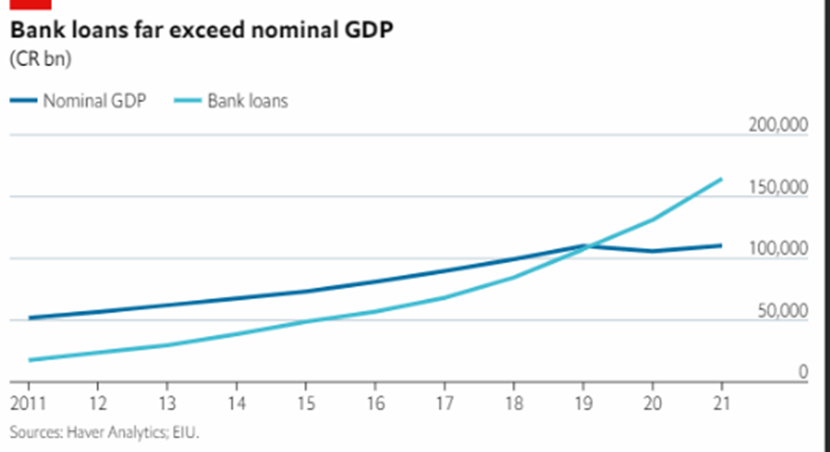
I have observed the Cambodian economy over the past several years. I know that salaries are only a few hundred dollars a month, but I see these same hard-working people driving conspicuous-consumption vehicles, for which they must have borrowed thousands of dollars at high interest rates. However, as in the stories my sister tells me, they have managed to make ends meet and keep afloat, that is, until the recent energy crisis.
This rise in energy costs comes amid a perfect storm of economic hardships, based on at least two other ‘black swans’.
First, the property market has crashed. Go to the outskirts of any Cambodian city, and you will see rows and rows of empty ‘boreys’. In the past decade, investors (largely Chinese, possibly interested in money laundering), have built thousands of these housing units, which no one wants to buy. If you have a house that you want to sell, lotsa luck!

Typical Borey. These are mostly empty.
Secondly, Trump foisted his tariffs on Cambodia. At first, it was 49%, but in order to pacify both Cambodia and Thailand at the beginning of their border war, he graciously lowered it to only 19%. The Cambodians were so grateful! I see it like this: Trump threatens to cut off your arm, but then he cuts off only your hand, and you are eternally grateful.
The tariffs are hurting Cambodia’s lifeline – the garment industry. If garment exports to the US are heavily taxed, demand will go down, and many factories will be forced to close, sending young girls back to their villages into poverty and most likely prostitution or other degrading activities.
I fear that the recent energy price increases may be the straw that breaks the back of working Cambodians. What are the implications of that? For one thing, banks may fail, due to an avalanche of nonperforming loans. For another, the conspicuous consumption in cars and houses may come to an end, as families are forced into much more modest lifestyles. One positive point: Cambodia produces a lot of its own food and other products. Cambodia may prove to be remarkably self-sufficient.