I was taking my morning walk in the gardens behind Wat Kandal in Battambang, when an Indian-looking guy came up to me saying “Shiva, Shiva”, and pointing to a remote corner of the gardens. There I found a new statue of Shiva, complete with his identifying symbols of the trident, the third eye, and especially the linga. It didn’t look like the typical Khmer style of statue, so I figured it was placed there in the past month by the local Indian community.
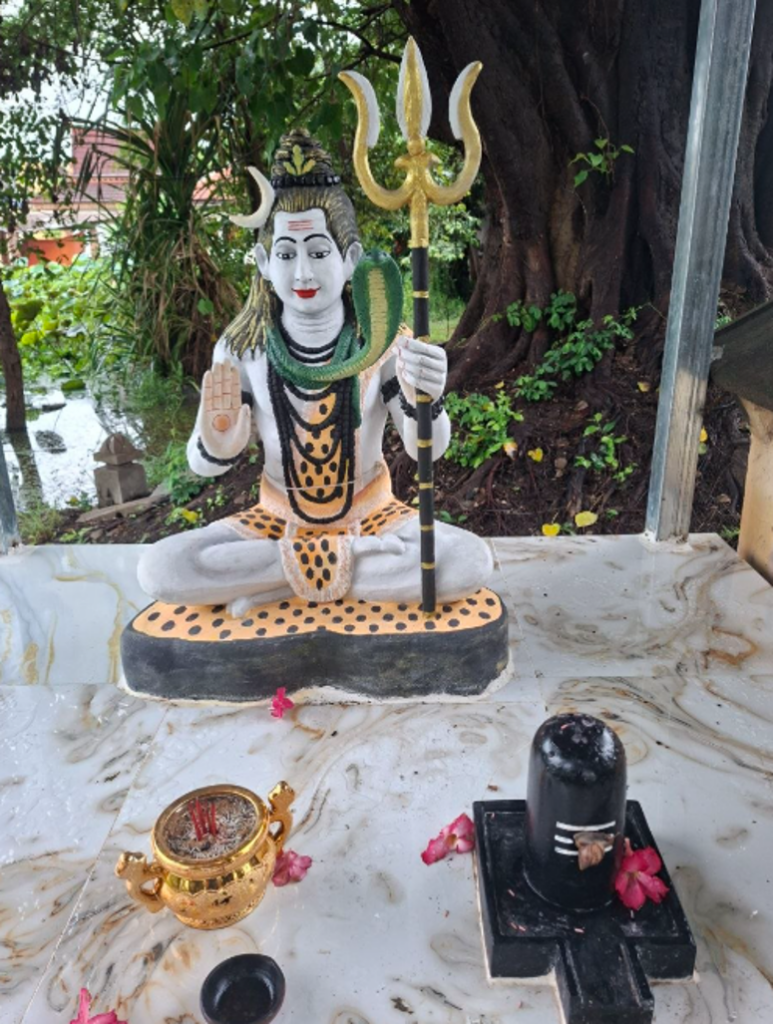
It struck me that Shiva statues are rare in Cambodian pagodas these days, but I realized that it hadn’t always been this way.
In fact, in early Cambodian Hindu times, Shiva was perhaps the most important of the Hindu gods. By the time of Jayavarman II (770-850) on Phnom Kulen, Shiva had reached such importance that the king developed the concept of deva-raj, or god-king, in which Jayavarman II believed himself to be the incarnation of Shiva. The amazing carvings in the streambed at Kbal Spean were largely about Shiva, so that the stream became known as the ‘valley of the 1000 lingas.’
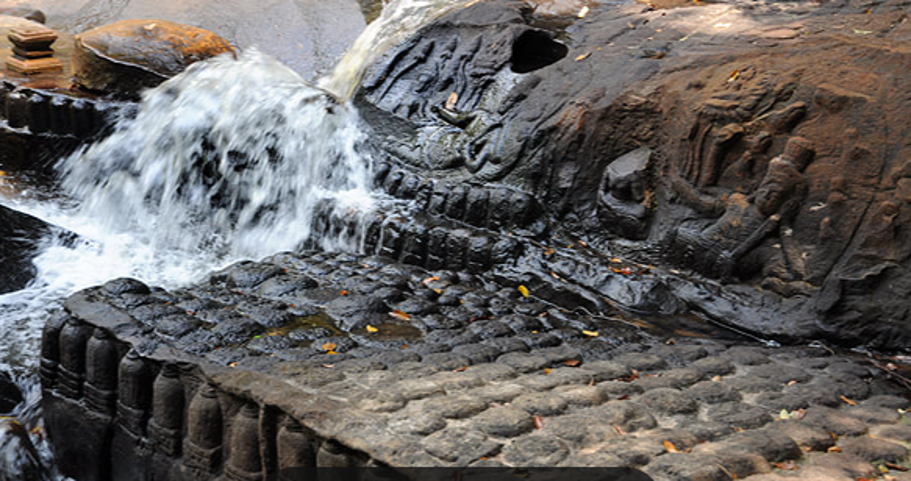
Lingas at Kbal Spean
The website hdasianart.com describes the linga as:
Simple in form yet vast in meaning, the Khmer linga represents both the cosmic principle and the spiritual foundation of kingship, fertility, and divine presence. https://www.hdasianart.com/
At the heart of each state temple—such as Phnom Bakheng, Baksei Chamkrong, or Pre Rup—stood a linga consecrated with the name of the reigning monarch, effectively identifying the king with Shiva.
This practice, known as the Devaraja cult (“god-king”), transformed the linga into a cosmological anchor:
Shiva remained the most important god to the Khmers for another two centuries. Banteay Srey temple near Angkor Wat was built by two royal courtiers (but not by any king) in 967, and was dedicated to Shiva.
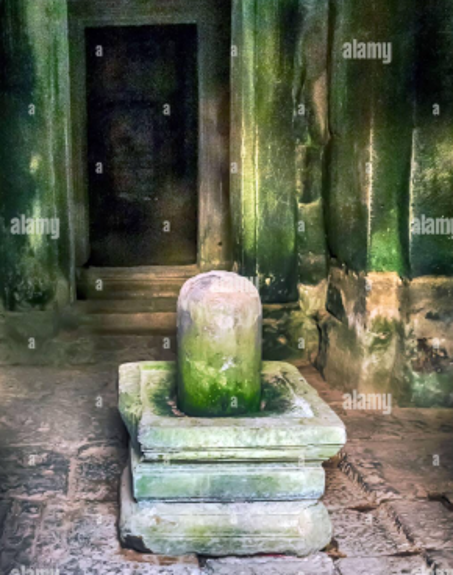
Shiva linga at Banteay Srei.
Suryavarman II dedicated the well-known temple at Preah Vihear to Shiva in the 11th century, although later it was converted to a Buddhist temple.
When Suryavarman II moved to the Angkor area, he built Angkor Wat in the early 1100s, but this temple was dedicated to Vishnu, not Shiva. From then on, Shiva was relegated to a minor role, especially when Cambodia became more predominantly Buddhist.
It has been widely discussed how Cambodia could be a Buddhist nation and still retain the Hindu gods.
Sadakata’s explanation is the fact that Buddhist cosmology has become, spiritually speaking, irrelevant. More precisely, he says: “Buddhist cosmology is a spiritual legacy of the past, yet it remains a force capable of stirring the imagination of people today. Like old ceremonial garments no longer worn, it retains an attraction for us and can transport our minds to the spiritual world of ancient and medieval people” (Sadakata, 1997: 177).
[Nowadays, Vishnu — the preserver — is the most common god in Cambodia. His image is found in homes and at city gates, as a protecting spirit.]
In this way, a statue of Shiva in Buddhist Cambodia is more a monument to the glorious Khmer past than it is an object of devotion or prayer. However, to Hindus from India, the statue is indeed an object of veneration and prayer.