THOUGHTS OF A NEW FATHER

A lot of my readers are fathers and will have experienced similar thoughts to mine: the miracle of life, the wonder of witnessing a new human being, etc. So what I’m expressing is probably nothing new, but I feel like expressing it anyway.
 

One of my first thoughts at seeing my newborn son was that one year ago, this amazing creature didn’t exist at all. Even the sperm and egg didn’t exist a year ago — they were just a bunch of carbon and hydrogen atoms. For these disparate chemicals to come together and form this incredibly complex creature is truly a miracle.

The father of a newborn baby cannot avoid thoughts of Creationism. Surely there must be a guiding hand behind this creation of life. The old saying, “There are no atheists in foxholes,” should apply to new fathers as well.

Not only is this new life wonderful in itself, it is pre-programmed to develop. The DNA code dictates that certain changes will take place, at puberty, for example. In that little helpless baby are the seeds for creative or mathematical abilities, for how tall they will be in 30 years’ time, for personality types.

When I look at my baby, and when I look at my other son (now 3 years old), one thing that I do not see is evil. Young children do not hate. Does our DNA program us to hate, later in life, people who are not identical to us — blacks, Muslims, LGBTQs? If my baby is created by God, does God want him to grow up with the notion that he should kill gays and other minorities? I think not.

When I look at the hatred expressed by Christian Evangelicals towards minorities, I think I could make a pretty good case that Satan is at work. While I do not see Satan in my baby, I certain see him in many so-called Christians.

How can this happen? There may be many causes, but I feel that one culprit is the illogical leap from Creationism to morality. “God created me, therefore I must act in a certain way.” There is no logical connection here. My baby is not going to get his moral compass from God, who created him. Remember “Kill a commie for Christ”? Does my baby’s DNA program him to want to kill communists? It is society (of which I am admittedly a member) which will instill moral values in my baby. (There is, however, some research challenging this.)

I am getting close to those old French philosophers, here. Rousseau: “Man is born free, but everywhere he is in chains.”, or Voltaire’s ‘tabula rasa.’ To me, it seems that modern genetics shows that a baby is not completely a tabula rasa, but maybe only a moral tabula rasa. That is, a baby may be programmed to develop in a lot of ways, but I don’t see any moral programming. I see my baby as born without hatred or evil, but I have to wonder whether I will be the one responsible for instilling in him that hatred for ‘the other’. Or is there some kind of ‘hate-the-other’ combination of genes.  I am at least grateful that my kids are bi-racial, so that at least they will not grow up to feel that they are the master race or master religion.
THE CHINESE/ CAMBODIAN CANAL IS A BIG DEAL

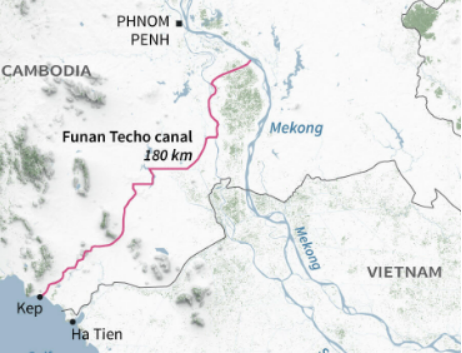
The canal will pass through Cambodia and will bypass Vietnam

Cambodia declared a national holiday for the start of the new canal, with parades, fireworks, the whole shebang. This canal will allow Cambodian river traffic to avoid passing through the Mekong delta in Vietnam. Phnom Penh will become a major river port, or perhaps some new city will spring up, such as Neak Leung, where Highway 1 crosses the Mekong.

Of course, this event probably didn’t register a blip on the world media screens. After all, by way of perspective, Cambodia’s population is 1/70th that of China, and there are individual cities in China that have more people than all of Cambodia. But this should be important. The canal will not only be a big deal for Cambodia, but will also have wide geopolitical repercussions.

Cambodia will be able to export rice to China along this canal, as well as import more Chinese products into Phnom Penh. Cambodia will become even more of a Chinese colony than it is already. The sinification of Phnom Penh will accelerate.

There will also be military advantages for China, as the Chinese navy will essentially control Cambodia, and can sail its fleet up into the Laos-Thailand area. Don’t forget, that the Mekong has its source in China. China has reportedly established a naval base at Ream, near Sihanoukville. But even without a naval presence, China will control the flow of water all the way from China through Cambodia.

[As an aside, recall that Pol Pot and the Khmer Rouge were more of a Chinese project than a lot of people realize. Does anyone ever ask the question, “If the Khmer Rouge sent millions of people into the countryside to produce bumper crops of rice, why were the people starving?” One-word answer: China.]

The effect of the canal will be to divert large amounts water from one of the world’s major rivers away from Vietnam. The Mekong is the life-blood of that whole delta region. I’m not hearing anyone worrying that it will cost Vietnam agriculture billions of dollars. Vietnam is not going to be happy about this. Not to mention environmental concerns for the entire region.  The construction of the canal represents, in many ways, a declaration of economic war against Vietnam.  Vietnam is already trying to shake off a lot of Chinese economic influence, and the canal may push Vietnam further into the arms of America and the West.

Finally, one must ask whether this huge loan ($1.7 billion), of Chinese money to Cambodia, is another one of those Chinese projects that eventually bankrupt the borrower so that China can take over the entire ownership of the project.

A HAMAS CONSPIRACY THEORY

I have written, in earlier blogs, about Hamas’ goal and strategy: the destruction of the State of Israel though global outrage against Israel . To reiterate a bit:

First, the October 7 incursion into Israel was not designed to topple Israel in one fell swoop. Rather, it was to provoke Israel into a blind rage of destruction that would create a global outrage and a desire from neighboring countries to attack Israel. They knew very well that the United Nations would ring with cries of ‘disproportionate response’ after Israel laid waste large areas of Gaza.

(I’m old enough that Gaza’s daily TV announcement of the number of Gazans killed reminds me of the US ‘body count’ back in the days of the Vietnam War. For Hamas, the death toll, almost certainly grossly inflated, keeps reminding the world every day of how horrible Israel is.)

Secondly, Hamas used hospitals and schools for their military operations. They dared Israel to attack those hospitals, and Israel obliged. Now, the UN rang with cries of ‘targeting civilians’ and ‘genocide’. Hamas’ goal was to provoke such outrage that Iran, Lebanon, and the West Bank would be drawn into an all-out assault on Israel.

It wasn’t working, although there were signs that it might work when Iran sent hundreds of missiles towards Israel, but it stopped there. Gaza body counts and horror stories have become a boring, repetitive story that doesn’t make the front pages anymore. Time for a new outrage.

So Hamas’ next step was to publicly and conspicuously station its leaders in Iran and Lebanon, just daring Netanyahu to go after them. Again, he obliged by assassinating the leaders on foreign soil. Once again, Hamas is hoping that this outrage will provoke Iran and Hezbollah to launch an all-out war. It might just work this time.

“Hang on!”, I hear you cry. “First you claim that Hamas leaders were sacrificing thousands of innocent civilians just to create outrage, and now you claim that the Hamas leaders were sacrificing themselves? Ridiculous!” UNLESS….

What if political enemies within Hamas sent those leaders to places where they could be targeted by Israel? How about Yahya Sinwar, mastermind of the October incursion, who has now been elevated to be the head of Hamas?  Or to go even further down the rabbit hole, suppose those enemies secretly informed Israel just where and when those leaders would be easy targets. A power-hungry Sinwar, or whoever it was, killed two birds with one stone — not just eliminating the two leaders, but also perpetuating the strategy of outrage, to provoke Lebanon and Iran into total war against Israel.

We’ll see how this all plays out in the next few days, as Iran and Hezbollah plot their likely attacks on Israel.

CAN CAMBODIANS BECOME CHRISTIANS?

After the Pol Pot auto-genocide, Christian missionaries must have thought that the surviving Cambodians would be easy targets for conversion to Christianity.

When I first arrived in Cambodia in 1995, I saw a traumatized people. There were almost no psychiatrists to treat the PTSD that was rampant across the country. Not only had most of them seen their loved ones brutally murdered, many acquiesced into participation. The guilt must have been awful. Image a starving young man who, in exchange for a bowl of rice, had turned in his mother to be tortured and clubbed to death before his eyes.

Now along comes Jesus Christ, with the positive message that the young man’s sins will be forgiven. You can bet that conversion to Christianity would be a big temptation. Indeed, mass torturer and murderer Comrade Duch, overseer of the Tuol Sleng torture and killing prison, later converted to Christianity. His torture and murder of thousands of innocent Cambodians were now forgiven and he would go to heaven.

There is also collective guilt. A Buddhist nation must have asked itself, “How bad can our karma be to have deserved the murder of 2 million of our citizens? Is this what our Buddhism has brought us?” I might imagine a mass exodus from the Buddhist religion after the Pol Pot debacle.

I first came to Battambang, Cambodia, as a volunteer for COERR: Catholic Office for Emergency Relief and Refugees. COERR had set up operations in the refugee camps along the Thai border, and some wonderful people like Sister Joseen Vogt had worked with the refugees to train English teachers. Upon their eventual return to Cambodia, they set up the COERR school in Battambang, and I worked closely with these returnees, who were the best trained English teachers in the country.

Nearly 30 years later, many of these same Khmer people are still dedicated teachers at the — now 3 —  COERR schools. Wonderful people, but none of them are Christians, despite the propaganda blitz by the missionaries! That happened all over Cambodia. Estimates of the number of Christians range anywhere from 0.4% to 2% of the population, even by Christians’ own estimates. That’s not many, considering the missionary effort over 30 years, and a disproportionate number of these are Vietnamese boat people or non-Khmer ethnic groups.

What happened? Or rather, what didn’t happen? Buddhism has bounced back amazingly. The pagodas have been reconstructed, and monks are out collecting alms everywhere you look. I know almost no Christians among my Khmer friends, many of whom are survivors from the refugee camps. Clearly, the Khmer Rouge attempt to destroy Buddhism, by murdering all the monks and tearing down pagodas, failed miserably, while Christianity has failed to gain a foothold.

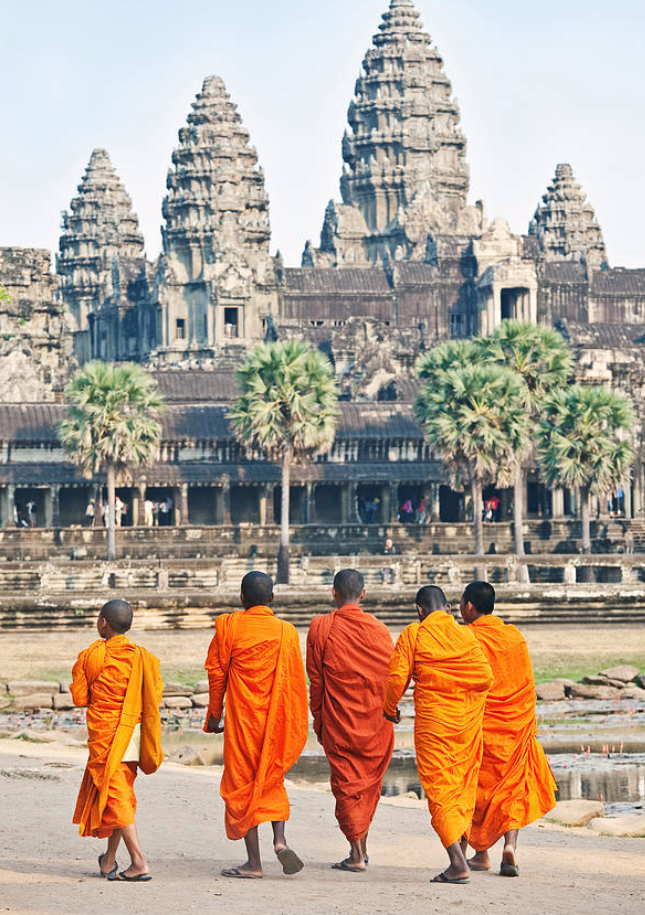
Buddhism is thoroughly ingrained in the Khmer personality. To use an overworked cliché, Buddhist values are ‘in their DNA’. The fact that they are one strong, unified culture across the country adds to this solidarity of their value system. This quality is explained brilliantly in a great book by Philip Coggan, called Spirit Worlds, in which one of the closing lines is, “To be Khmer is to be Buddhist.” It’s a question of identity. Khmer people still identify with the proud civilization of Angkor Wat and its God-kings like Jayavarman VII.

Religion is culture. So how must Khmer persons feel when Western missionaries arrive and tell them that their crummy Khmer culture is vastly inferior to Christian culture, the only true culture? They must feel this as an insult, an attack.

I worked a lot with missionaries in Africa, and I was always struck by their arrogant attitude that they had nothing to learn from the local Africans. They had all the answers, and were there only as teachers to bring the benighted natives into the light of Jesus. When they bring this same arrogance to Cambodia, is it any wonder that the proud Cambodians turn their backs?

I REALLY GREW UP IN APPALACHIA

J.D. Vance has been touting his knowledge of Appalachia through his book Hillbilly Elegy, even though he grew up in northern Ohio and knows very little about Appalachia, except for a collection of negative cliches that point to Appalachians as a bunch of genetically degenerate losers.

I actually grew up in a small town of about 3,000 in Appalachia — in the beautiful hills of southern Ohio — from age 7 to age 20.

Now that I’ve traveled the world, I have a global perspective on a lot of things. One thing that stands out to me is the frustration I feel with the computerized technology of everything. Even with all my online experience, I cringe at having to fill out an application for a bank account online, with passwords, proofs that I am not a robot, and instructions that I find incomprehensible. If I put myself in the shoes of some of my former Appalachian schoolmates who do not have my education or experience, I can see how they feel completely left out by society. No wonder they are angry, when they have just been rejected for a bank loan without being able to actually talk to anyone in person.

They HATE the educated elite, epitomized by Hillary Clinton, and they absolutely HATE being called ‘deplorables’ by East Coast snobs, but they adore uneducated people like themselves, who cannot figure out how to apply for a bank loan online. Enter Donald J. Trump. When he says that back in 1776 the Revolutionary Army took out the British Air Force, they can say, “Even WE know better than that.” In Trump they can actually look down on someone whom they can laugh at.

They probably like the fake image of J.D. Vance, especially that photo of him sitting with a shotgun in front of a pile of chopped wood. Makes him look like a real hillbilly. But if they read his book, they might see how he is looking down on them as a bunch of misfits.

He seems to treat Appalachians’ drug problems as genetic, as though there was a specific gene that makes them take drugs and then act stupidly. Back when I lived there, there was hardly a drug scene. Marijuana was just catching on, and that was more of a plaything for the upper class.

Vance’s condemnation of druggies turns a cause-effect relationship upside down. He points to drugs as the evil cause of all sorts of negative outcomes. I would argue that drugs are an effect, or result, of joblessness, of that feeling of despair, of being abandoned. In those circumstances, people turn to drugs as an escape hatch.

The magic of billionnaire Trump is that all his policies are designed to benefit the rich and screw the hillbillies, but since he is so anti-intellectual, they can identify with him. They share his victimhood. The feel that the whole establishment is out to get him…and them. They cheer when he says, “I am your vindication!”

West Virginia will vote solidly for Trump, even though all his policies are designed to screw them…take from the poor and give to the rich. They believe that he will ‘drain the swamp’ of all those ‘deep state’ educated East Coast liberals, and replace them with uneducated hillbillies like themselves.

I think that people are beginning to see through Vance as a phony and an opportunist. A second reading of Hillbilly Elegy might reveal that he is only writing a self-serving memoir, and that he doesn’t understand Appalachians at all.

CHERCHEZ LE PATRONAGE

If a Westerner observes some act of Cambodian behavior that he finds rather bewildering, my advice is: ‘cherchez le patronage’. Khmer society is governed by a system of patronage, where every person owes allegiance to their ‘bong’, very much like the old European feudal system, or in some ways like Chinese Confucianism. The patronage mindset may be at the root of the unexpected behavior.

In this system, an employee ‘belongs’ to the patron, or ‘bong’, not to thecompany or group. When I first came to Cambodia, I noticed that when the company boss’s sister was getting married, all the employees were expected to serve as waiters, greeters, etc. at the wedding. A Western employee might have complained, “But that’s not my job; I don’t even know the sister.” But the Cambodian employee would not feel slighted at all, nor would it even cross their mind to complain. If the bong decrees it, then it must be done.

Indeed, in Cambodia, the company and the person-in-charge are not separate entities. The company vehicle is the bong’s vehicle. For example, it used to be the case the company that was Northwest Cambodia’s biggest employer had all its financial records and bank accounts in the personal name of the CEO. There was no formal distinction between company moneys and personal moneys.

One advantage of the patronage system is the smooth running of society. Everyone knows their place and no one rocks the boat. Cambodia has been remarkably stable for the past 25 years. (Add to this the absolute horror of returning to the violence of the Khmer Rouge days.)

One disadvantage is that there is little team spirit. People do not identify with a team or group working towards a common goal. Rather, all their actions are to serve the bong. One of Mao Tse Tung’s first initiatives was to form gung ho groups – meaning ‘work together’.

Non-Khmer employees are also frustrated when they have a good idea to share with the boss. It’s like talking to a brick wall; only the bong‘s own ideas can be considered. What’s worse, the bong will pretend to listen attentively to the new idea, but later, the employee is frustrated when no action is taken.

Both Mao Tse Tung and Pol Pot saw the inherent inequities in such an entrenched hierarchical society, and they both tried to coerce the people into an egalitarian society, even if it meant killing off millions of people who adhered to the old, feudal system. Of course, they both failed. That shows just how thoroughly entrenched the hierarchies had become.

Years ago I saw a study done in Hong Kong, in which people were asked how they felt about the grossly unequal economy of Hong Kong. People didn’t express a need to tax or otherwise bring the super-rich down to their level. Rather, they just wanted to be rich like the elite. If the bong was ordering them around, they wanted to change places and be in a position to order other people around.

People in Hong Kong saw how the elite cheat and manipulate situations in order to rise to the top, but since people just want to emulate the elite, they accept the notion that corruption of all sorts is just part of the game, and they are even jealous that one person can succeed in bamboozling the authorities when they themselves cannot.

I have seen this attitude in play in Cambodia, where foreign employees complain about illegal or unethical behavior by the bong, while the local employees simply accept such behavior and may even be envious that the bong can get away with it.

I said that the Cambodian patronage culture reminded me of Confucianism. However, I get the feeling that there is a subtle difference (but I stand to be corrected). The philosophy of Confucianism saw ‘filial piety’ as a means towards the end of a smooth-running society. Cambodian culture sees the perpetuation of the patronage system as the end in itself.

Cambodians who witnessed the horrors of Pol Pot’s supposedly egalitarian system rapidly returned to the safety of their old patronage system, which now appears to be more deeply entrenched than ever.

CAMBODIAN DEBT

Here’s a small factoid:  Cambodian private debt is 180% of GDP. 180%! In layman’s terms, this means that the average private Cambodian is in debt up to their eyeballs. All those new cars and new houses are not paid for, and as far as I can see, will never be paid for. They will all be repossessed, and Cambodia will to belong to the banks, if it doesn’t already. Or, perhaps more common, the debtor will sell the land or car to some entrepreneur in order to settle the debt. Even someone who can afford a $30,000 car will borrow more to buy a $50,000 car.

According to a Licadho study, over a quarter of all households spend more than 70% of their income on debt repayment. And 93% of microloan recipients are required to pledge at least one land title as collateral. Those microloans have insanely high interest rates.

On the other hand, Cambodian GDP is growing at over 7% per year. The economy is booming. Or is it?… What the heck is going on?

On my street in Battambang, there is a constant turnover of restaurants. Capital is invested, but then there are no customers night after night, so that in 3-6 months, the place closes, and within a day or two, the place is being remodeled for yet another new restaurant. Outside of town, there are literally thousands of new housing developments that are empty, or that have ‘for sale’ or ‘for rent’ signs. Doesn’t sound like a booming economy to me.

However, there appears to be plenty of venture capital floating around to finance new restaurants and new housing developments. Every time a new house goes up, the GDP goes up, regardless of whether anyone will actually live in the house. The banks evidently have plenty of money to lend, knowing that the land will serve as adequate collateral.

Where is all this capital coming from? In a word: China. In 2023, China experienced record-breaking capital outflows at $53 billion. I follow the Chinese stock market, and it has gone down at least 10% in recent months. All that sold stock money must be going somewhere. And Cambodia has had a reputation of being an easy country to launder money. Just look at that plethora of different banks — eight of them right in a row in Battambang. Where do you think all that money is coming from?

What does the economic future hold? I’d guess pretty much the same, as Chinese capital continues to flow into Cambodia, building new empty housing developments and businesses. So the GDP will continue to rise.

One thing that could change is the Cambodians’ optimistic attitude that you can just borrow money and not worry about the consequences. Too many Cambodians are losing their shirts in risky ventures. Maybe they will begin to learn that you can’t just borrow money that you probably can’t pay back.

Or maybe there’s something else at play here. All those 3-6 month restaurants on my street might be planned failure, for some reason that I can’t fathom. Surely those investors have a pretty good idea that their restaurants will fail. Any developer can see all those literally thousands of empty houses, yet still they invest in more of the same. I don’t get it, but I suspect that money laundering has something to do with it. But still, why would a money launderer intentionally lose money?

The Cambodian economy is an enigma.

WHAT I’M NOT HEARING ABOUT IMMUNITY

The media have been going berserk talking ad nauseum about Presidential immunity. But it seems there are many questions that they are not asking.

  1. Is immunity from prosecution the same as immunity from impeachment?

Does this ruling mean that there can be no more impeachments of Presidents? Can the Republicans forget about impeaching Joe Biden?

If so, can a former President be un-impeached? Trump’s infamous phone call to Ukraine, offering the release of US weapons if they would dig up dirt on Biden, was an official act, therefore immune. Can that impeachment be reversed? Would it matter?

2. Suppose Trump, as President, orders a Navy Seal to assassinate Biden. OK, he is immune from prosecution, I get that. But what about the Seal? If he carries out the (legal) order, he himself is committing a crime, and he can be prosecuted, even if the President cannot. Or if he refuses to carry out a legal order, can he be court-martialed and thrown into jail?

And by the way, if the President orders an assassination, is that order itself now legal? Or is it illegal, but the President cannot be prosecuted for his crime, which is still a crime? Is the President a criminal or not?

3. In its decision, SCOTUS made a big deal about the separation of powers. The logic seemed pretty vague to me, but it appears to boil down to the fact that a President’s official acts are part of the Executive Branch, and the Judicial Branch has no business meddling in that separate Branch.

If that’s the case, what about Cabinet members and other members of the Executive Branch? Are they also immune on the same grounds? Suppose the Vice President orders someone to shoot Biden; is s/he immune from prosecution?  

In its recent decisions, SCOTUS has been tying itself into legal knots trying to twist obvious truths into convoluted confusions. I can’t resist mentioning the recent decision on obstruction of a political process. The lower courts simply read the clear-cut law that states that the Jan. 6 rioters obstructed the Congressional certification of votes. But, no, SCOTUS found a way around that one.

They reasoned that the obstruction law was enacted to punish offenders back in the ENRON case, where the obstruction was of documents, not actions. Even though the law itself didn’t mention documents, SCOTUS reasoned that the law must have been about documents only, and that the Jan. 6 rioters were not obstructing documents, and were therefore not guilty under the law.

How’s that for a twist of the law? It makes a mockery of the ‘originalist’ interpretation of the Constitution. When the Second Amendment was written, the only ‘arms’ were muskets, and so, SCOTUS might argue, the Amendment applies only to the right to bear muskets, but not to semi-automatic assault rifles.

Unfortunately, I along with millions of other Americans, have lost all faith in the Supreme Court. It has become just another wing of MAGA.

PRIVATE EDUCATION IN DEVELOPING COUNTRIES

Public education in almost all developing countries is under-funded, and therefore of poor quality. One result is that developing countries fall further and further behind developed countries in human capital. Their poorly educated graduates just cannot compete with those from developed countries.

Private schools spring up in developing countries in order to meet the demand for higher quality graduates. Of course, poor families cannot afford to send their children to private schools, so this situation exacerbates inequalities in the social fabric. Education is only for those who can afford it, and they will benefit with better skills, jobs, etc.

In fact, there are inequalities even within the private system, as the very elite can send their children to the most elite schools, while the middle class must be content with more middle class private schools.

Worse, every student who attends private school is one fewer for the public education system to cope with. Governments welcome private education, as it relieves them of much of the burden of providing quality education for all. If you are a parent sending your children to private schools, you won’t be pressing government for better public schools.

Even worse yet, the government ministers and all their friends and relations send their children to expensive private schools. For them, there is no problem with the educational system. The poor schools, especially those out in the countryside, are out-of-sight, out-of-mind. The public education system becomes forgotten, as government shirks its responsibility.

Since there is a hierarchy of private schools, the richer schools become symbols of conspicuous consumption for the rich — status symbols. The elite send their children to elite schools not for their educational value, but for their snob value. The richer schools become country clubs, where status symbols become more important than learning.

The owners of these private schools understand this. They are in the game for the money, not especially for the education. Education is sacrificed to profits. The owners also realize that these parents are easy to fool. The owners preach ‘quality!, quality!, quality!’, when in reality, quality is sacrificed to false images, glitzy buildings, swimming pools, and the like. Only a few dedicated teachers are interested in education, and they are often frustrated when they must forego science equipment in favor of a gaudy new Mercedes school bus.

In another post, I mentioned how these rich schools pretend to be ‘international schools’, when in reality there is nothing ‘international’ about them.

Cambodia has actually made great strides in public education. Twenty years ago, the grade 12 examination system was so rotten that it became the butt of a lot of jokes. Today, the grade 12 exams are more or less legitimate, as students must actually learn things in order to pass. Thus, public education is at least an option for students, whereas in the past it really wasn’t. This competition may be forcing the private schools to become more extreme when it comes to the country club mentality.

At one of the prestige private high schools in our city, the pass rate on the state grade 12 exam was actually below the national average of public schools. Why would a parent send a child to that school, when they would learn more at a public school? However, the attendance at the private school is still booming. It would seem that there are priorities other than learning at issue there.

One problem with Cambodian society is its patronage system, as opposed to meritocracy. The old adage, “It’s not what you know, it’s whom you know,” applies on steroids in Cambodia, to the extent that learning in many schools and universities has become almost irrelevant, if not non-existent. A few years ago I was asked to help interview our university finance major graduates working in banks. I went to all the major banks, and couldn’t find a single one of our finance graduates. They were working in their daddies’ businesses in other fields, not finance. From what I have observed, their knowledge of finance and banking was nearly nil, despite four years of university. Can you imagine an accounting graduate who doesn’t understand compound interest?

This has all been pretty negative, but I have hope for Cambodia and for similar countries. As Cambodia is drawn more and more into the arena of international business, there will be an increasing need for employees who can actually do something. Thus, I see a trend — slow, I admit —  away from the current know-nothing patronage towards some kind of meritocracy. This will require schools and universities actually to teach the students something. There are a few schools in Phnom Penh who are realizing this and are requiring their graduates to learn useful skills.

Still, the requirement for useful skills will further exacerbate the rich-poor divide, as the elite will have the educational qualifications for jobs, while the poor will not. That is the dilemma for developing countries around the world.

DOES A FETUS HAVE A SOUL?

This is not a political screed about abortion. I have placed it in my ‘Religion’ category.

My thinking was stimulated when a friend told me that I would someday see my deceased daughter in the afterlife. My first question was: “She was 7 when she died. Will she still be a cute 7-year-old whenever I meet her?” A secondary question was, “If I’m a senile old man when I die, will I still be that decrepit creature when I meet her in the afterlife?”

From there, my thoughts turned to my unborn son, due next month. If he was aborted or otherwise died, would his soul go to the afterlife? Would he still be a fetus in the afterlife? Would he remain inside his mother, or would he somehow exist independently?

Let’s assume that a fetus has a soul. Perhaps the first question to raise would be, “Where did that soul come from?” Did it exist before conception? Did that soul reside in a sperm cell, or within the mother’s egg. No, I don’t think so. Both sperm and eggs didn’t even exist at some point before conception, and were created out of bodily chemicals. That would imply that all billions of sperm cells and eggs have souls, but they die before conception. But then, would those souls have an afterlife? No, this is ridiculous.

Maybe those souls were waiting out there in soul-land for a body to enter, and then entered the fetus at conception. There are 8 billion souls in living human beings in the world. Have they all been waiting out there since time immemorial? There were only a billion people only a few centuries ago. Where were those other 7 billion back then? No, I think the idea of billions of souls waiting from the beginning of time is not an idea that I can take seriously.

So I conclude that a new soul is created at conception or afterwards, and may have some kind of ‘soul-DNA’ from both parents.

But then, what about identical twins? They start out as one egg-sperm combination, but then, not simultaneously, the egg sometimes splits and may end up in two placenta, I.e. as twins. Does it have one soul upon conception, which then divides into two twin souls afterwards? That would mean that a separate soul is created after conception. That seems unlikely to me.

Suppose next that a fetus dies before birth. Does it develop so as to be somehow ‘born’ as a person in the afterlife? That doesn’t make much sense if the mother is still alive and not in the afterlife. And yet, I can’t imagine that it remains a fetus forever and ever.

Cambodian Buddhism has an interesting take on this. Despite the central doctrine of reincarnation, the Buddha refused to answer a question on the existence of the soul. Apparently, the ‘self’ that is reincarnated is not the same concept as the soul.

Further, in Cambodia there is a concept of pralung, something like life-force. All living creatures, including plants, have this. The human pralung is not a unique force; indeed, each person has 19 different pralung, which can enter or leave the body. The fetus has pralung, but it is not clear where they come from.

Islam has an interesting answer. The fetus at birth has no soul, but a soul is somehow ‘breathed’ into the fetus at the age of about 120 days after conception. Not a bad idea, but I have trouble with the idea that one second a fetus has no soul, and the next moment it does. Then we get back to the question of where that soul comes from. Clearly not the mother and father, but rather from the outside somewhere. Moreover, the Islamic version avoids the question of a billion-year-old soul just waiting to enter a new body; rather, Islam has God creating a new soul for each person, after conception.

That brings me back to the question of age. If a small baby dies, does its soul grow older: does it mature to adulthood in the afterlife, or is it forever fixed as a baby. On the other hand, if an old person dies, does their soul grow even older and more decrepit, perhaps to 200 or 300 years old, like the portrait of Dorian Gray? Or do they somehow revert to some golden age of, say, 30, forever.

Related questions: will Michael Jordan play basketball in heaven, or will he be too old? Does Liberace have his piano in heaven? If I am attached to a pet dog, will I see my dog in heaven? Do dogs have souls?

All these imponderables appear ridiculous to me. I have to conclude that, if indeed the soul somehow exists, there must be some kind of non-physical soul-stuff in heaven, and that when we die, our non-physical soul merges with the great soul-in-the-sky. In short, I can’t see myself recognizing my erstwhile 7-year-old daughter, at least not from her appearance. I can’t even see myself recognizing myself, for that matter. However, if we had formed a strong spiritual bond during her life, that spiritual bond might somehow exist beyond the grave, within the great, timeless Ur-Seele.