Trump’s tariffs, the oil blockade, etc. have destroyed what was left of the interconnected world economy.
Until recently, a car assembled in the US, for example, contained hundreds of parts from all over the world. A vast web of arrangements allowed parts to be shipped from one country to another. We really had a global economy.
The world has learned that all that cooperation was just an illusion. It didn’t take much to destroy the trading network.
Trump thinks that a tariff levied on, say, Canada, is a punishment on Canada. It’s really a punishment on US companies and consumers, who must pay the tariffs, leading to higher prices. Trump’s tariffs, therefore, are shooting himself in the foot. Canada’s only loss is that, with higher US prices, people will not buy as many of their products. Too high a tariff, and Canada will not sell ANY products.
Even after Trump has left, and his crazy tariffs withdrawn, the world will remember just how easy it was to destroy the entire global trading system. They will remember how trust was broken, and treaties revoked. They will hesitate to rush into new agreements that may be broken.
The world will realize that Americans elected Trump, twice. Thus, Americans can and will elect officials who will break agreements. It will take many years for America to regain the trust of other countries, who will mistrust America and American voters as a whole, not just Trump and his cronies.
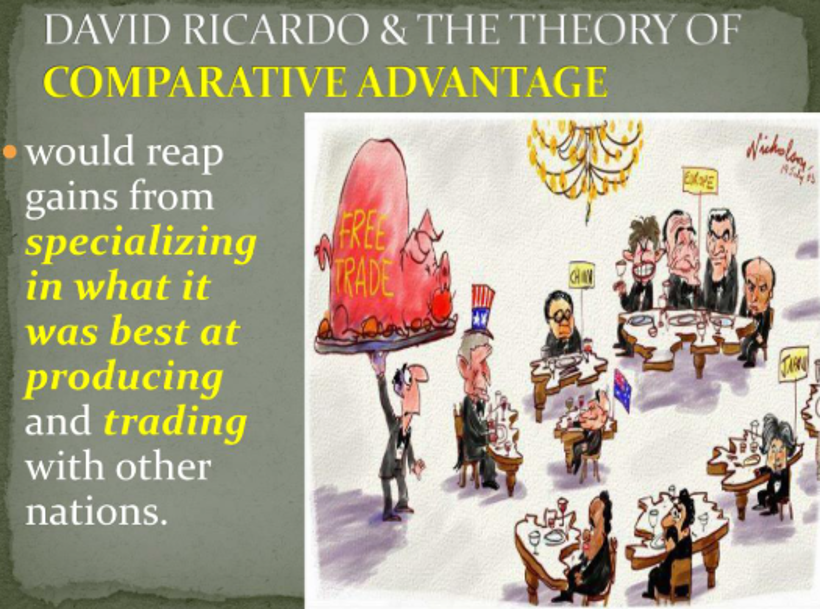
According to the classical economist, David Ricardo, free trade is beneficial to both trading partners. Ricardo’s theory of comparative advantage states that if one country, say Brazil, is good at producing one thing like coffee, and another country, say Canada, is good at producing something else, like maple sugar, then both sides benefit by trading those products if they focus on producing what they are good at. Without such trade, consumption of those products would be impossible, or at least more expensive.
I lived for 4 years in Lesotho, surrounded by apartheid South Africa. In those days, the entire world was boycotting South Africa. The boycott forced South Africa to become amazingly self-sufficient. That included even being the only country in the world to be able to produce gasoline from coal. [They had plenty of coal, and no country would sell them oil.] South Africa had the geographical and climatic diversity to produce just about anything on their own.
The apartheid South African example may signal the future of the world economy. If no country can depend on trade with another country, because of war, tariffs, etc., then countries will retreat into protectionism and self-reliance. Life will become much more expensive, and many products will disappear from the market. Americans cannot produce coffee, so a ban on trade with coffee producers will result in a ban on coffee in America.
Be prepared for a world of self-reliant countries, where many products will not be available at all, while others, manufactured within the country, will be much more expensive.