Every morning I walk over to the local pagoda. After some Qi Gong meditation, I just sit on the swing, drinking in the beauty of the place. Not just the visual beauty, but the sounds, especially some 20 identifiable surround-sound bird songs.
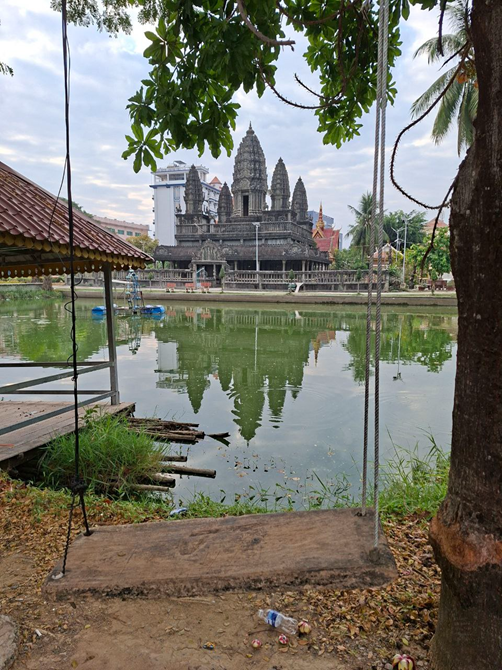
My swing at Wat Kandal
This right-brained experience leads my left brain to analyze just what this experience of beauty is really all about.
Here is my simple-minded theory of art: the artist has a vision in his mind (perhaps visual, but maybe musical or poetic), which he then transcribes, using his technical skills, so that the recipient will appreciate his vision. Art is thus a communication between artist and recipient, and the value of that art is judged both by the richness or depth of the original vision, together with the technical skill used in transmitting it.
Of course, each recipient will appreciate different aspects of the message, because they bring their own background to the experience. That is why Plato insisted that “Beauty is in the mind of the beholder.”
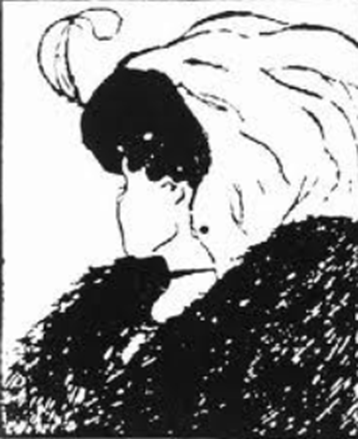
What was the original vision of this artist?
Now, back to the pagoda experience. Is the beauty I experience in nature the same experience as seeing a Monet Water-Lily painting, or listening to a Bach fugue? I believe it is. It is the appreciation of some aspect of the mind of the creator, perhaps ‘through a glass darkly’. Creator? Yes, I’m coming down on the side of Creationism. However, while the usual argument for Creationism is that the universe is too complex and orderly to have created itself, and therefore must have been created by something, my argument is that the universe is beautiful, and that beauty is communicated to us from some mind, or what I might call Ubermind, or pure Mind.
I conclude that my experience of beauty at the pagoda is a glimpse into the Creationist Mind. In fact, those of us who have had ‘peak experiences’ may realize that such an experience is a union with, or incorporation into, that Mind.
[Note that I am not connecting this to religion, which I feel is far removed from Creationism.]
This connection between art and Creationism was expressed by Beethoven: when he said, “Bach is the immortal God of harmony.” Bach himself wrote, “Harmony is next to Godliness.”