We just had the monks’ house-blessing ceremony for our new house. It raised many questions.
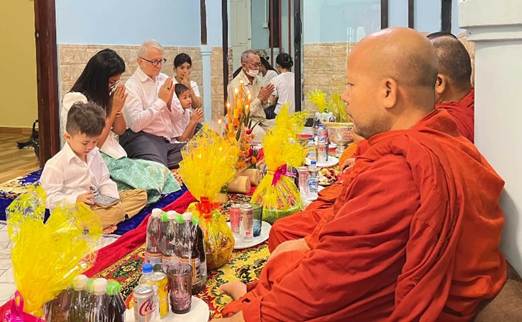
monks chanting at our house-warming
It was positively medieval and other-worldly. Of course, that’s the point: to perpetuate the continuity of traditions that date back at least a thousand years. Also, religious ceremonies in general are designed to transport people from the day-to-day profane world into the sacred universe beyond our sensory physical world.
Some of the ritual acts can be interpreted in the same way that they are in almost all religions. For example, the monks sprayed us with holy water. Obviously, this is a purification rite. They also showered us with flower petals. I suppose this relates to the abundance of life, fertility, etc.
Many religious ceremonies mark ‘rites of passage’ which are breaks in day-to-day time to mark certain spiritual mileposts – marriage, births, death, etc. Moving into a new house is a similar rite.
Most religious ceremonies are similar, and follow the prescriptions outlined above. Buddhism, however, has some odd quirks, because Buddhists don’t pray to gods.
Buddhist ceremonies are known for their chanting, maybe half in the ancient Pali language, and half in the local Khmer language, so that most people don’t really know what the monks are talking about. In Christianity and other religions with gods, chanting asks the gods to ‘bless’ (whatever that means) the house and its occupants. This can’t be the case with Buddhist monks, who don’t worship gods as such, nor can it be a petition to the Buddha, who was not divine.
Rather, it would seem that the chants are themselves magic words that somehow affect the house and the residents. Many religions believe in the magic power of words. Burning the Quran is blasphemy, not because it burns some paper books, but because it destroys the sacred written words therein.
But why, then, couldn’t the householders chant their own magic words? Who needs the monks?
Recall that, during the Middle Ages in Europe, the priests prayed on behalf of the commoners in Latin, which the commoners could not understand. In most religions, the priests are the go-between between the gods and the people. Through their rigorous training, the priests learn to communicate with the godhead, and to transmit messages in both directions between the gods and the people.
Buddhist monks appear to fulfill a similar role, but there are no gods to communicate with. Rather, the monks have access to the spiritual world outside our physical world. The words of their chants reflect ‘meaning’ in the spirit world, which is an intermediate communication between the spirit world and the people, who themselves are unable to access the spirit world.
When I was in university, I had to read Mircea Eliade’s ground-breaking book, The Sacred and the Profane. Eliade argues that religion is based on a sharp distinction between the sacred and the profane. According to Eliade, for traditional man, myths describe “breakthroughs of the sacred (or the ‘supernatural’) into the World”—what he calls hierophanies.
In this way, the monks’ ceremony, with all its chanting, symbolism, and magic, is a typical hierophany, in which the sacred breaks into the profane world. No gods are necessary for this religious experience.